

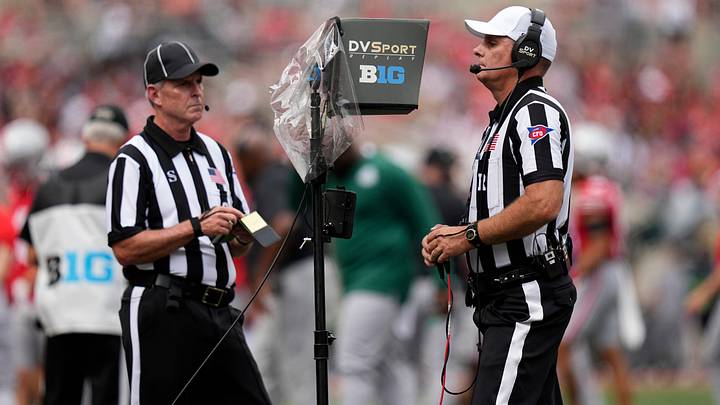
Another week, another cavalcade of mistakes by Big Ten officials across multiple games forces the conference to issue corrections, falling just short of an apology—and underscoring a simple problem: the conference keeps fixing errors after the fact instead of preventing them.
At what point do commissioner Tony Petitti and whoever hires the officials get embarrassed enough to do something about the repeated, inexcusable mistakes that stem less from judgment calls and more from not knowing the rules they’re enforcing? At what point does a conference flush with cash invest more money in training and competency for the officials whose mistakes have even handed a win to a team that didn’t deserve it?
The Big Ten’s problem this week was a few calls in the Nebraska game against Indiana: the referees mostly let the two teams play without interference, but still blew a few calls that tilted the game in Indiana's favor.
ESPN’s Matt Schick pointed out that on one play in particular, where an Indiana receiver made an important 3rd down catch, there was a chance he didn’t make the catch at all. The issue, as Schick pointed out, wasn’t that the officials definitely got it wrong, but that when the replay booth looked at the play, they didn’t even look at an angle that cast doubt on whether the receiver held the ball all the way through.
It doesn’t look like the review center watched the most important angle, which showed the ball hit the ground as he came to the ground. pic.twitter.com/hb5WH3pvro
— Matt Schick (@ESPN_Schick) October 10, 2026
Tony Petitti faces growing Big Ten officiating problem after another weekend of rule mistakes
That begs the question: what is the point of replay if the people working it aren’t going to do everything possible to get the call right? That play came one week after Nebraska and Maryland were seemingly flagged on nearly every play, and the Huskers set a school record with 16 penalties. Several calls were wrong, and NU head coach Matt Rhule was livid after the game.
"I thought it was ridiculous," Rhule said in his post-game press conference after beating the Terrapins 48-23 despite the number of penalties called on his team. "I thought it was poorly handled by the officials and poorly done by us. You've never heard me say that before, but I was frustrated today. There were things I've never had called before."
Rhule added that he thought he’d probably be fined for his comments. Not only didn’t the Big Ten fine him, but the conference also issued a statement the following Monday saying the officials incorrectly handled a “roughing the snapper” penalty on Nebraska’s final point-after attempt. 16 judgment-call penalties are one thing. Not knowing the rules is something else.
Nebraska wasn’t the only victim of poor officiating in Week 6. Elsewhere in the Big Ten, Michigan State lost to Illinois, 38-37 in overtime, largely because the Spartans recovered an onside kick that officials called back after saying an MSU player was offsides. Later, Michigan State fans pointed out that it’s hard to see how anyone could have been ruled offsides on the kick that might have let the Spartans win in regulation.
This was called offsides by the officials, taking away Michigan State’s recovered onsides kick.
— Justin Thind (@JustinThind) October 10, 2026
This was the fourth suspicious call (or no-call) going against MSU in this game. Just a stunning day for the refs in this MSU - Illinois game. pic.twitter.com/Mm2OXcYY5B
In the Oregon vs. UCLA game, the Ducks looked poised to rally from behind to tie at 17 when they scored a late touchdown and attempted a two-point conversion. The first attempt was stopped, but officials flagged UCLA for a facemask, and Oregon got a second chance.
On Sunday, the Big Ten issued a statement announcing the referees spotted the ball after the penalty incorrectly:
“Following the first attempt that resulted in a personal foul penalty for a facemask on the UCLA defense,” the Big Ten said in the statement. “The ball was spotted for the second attempt half-the-distance to the goal from the original line of scrimmage of the first attempt. Per rule, the ball should have been spotted half-the-distance to the goal from the end of the run of the first attempt.”
How does an officiating crew that conferred about where to spot the ball not know that rule?
In the end, the mistake didn’t affect anything, as it would have moved the ball only a few inches forward, and Oregon was stuffed behind the line on its second two-point conversion attempt. Even so, the Big Ten’s constant need to correct its officials after the fact remains the real issue.
The string of embarrassing faux pas started with the biggest of them all this season, when Michigan tried and failed to hit a Hail Mary in the final seconds of a game they should have lost to Western Michigan. The officials ruled there needed to be one second put back on the clock, and Michigan got another Hail Mary try, this time completing the pass and winning the game.
After the Big Ten tried to claim the officials were right, the NCAA Oversight Committee said no, they were not, and Western Michigan should have won the game. Unfortunately, the committee didn’t have the power to change the result.
The mistakes detailed here are hardly the only ones Big Ten officials have made in recent years. Back in 2024, Matt Rhule was so frustrated with the mistakes that he went out of his way to say Nebraska didn’t want any more apologies.
No one should want any more apologies. At the very least, everyone wants Big Ten officials to understand the rules they’re enforcing. That the conference itself doesn’t seem more dedicated to that rather simple mission is the real concern.
 Add us as a preferred source on Google